
How to Find Ingham County Arrest Records
The fastest way to look up a recent Ingham County arrest is the official Ingham County Inmate Locator at jail.ingham.org. The locator is hosted by the county and shows who is in jail right now. The search form has two tabs. The Name tab takes a last name and first name. The Inmate Number tab takes the booking number. A CAPTCHA must be solved before the form will submit, so the page cannot be queried by a bot. The roster lists current bookings only. A person who has been released, transferred to the Michigan Department of Corrections, or moved to a federal facility will drop off the local roster.
If the person is not on the local roster, the next step is the state-level criminal history check. The Michigan State Police run the Internet Criminal History Access Tool, known as ICHAT, which is the official statewide source for adult conviction data. ICHAT does not show arrests that did not lead to charges, and it does not show juvenile cases. To pull docket-level information after charges are filed, the Ingham County Court Record Search covers Circuit Court back to 1986 and criminal cases back to 2000. The search portal warns that online results are not the official record.
- Open the Ingham County Inmate Locator and pick the Name tab. Type the last name first, then the first name, and solve the CAPTCHA before you click Search.
- If the person is not in current custody, run a name search at courts.ingham.org for any open Circuit or District Court case tied to the arrest.
- For a sworn statewide check on adult convictions, order an ICHAT report from the Michigan State Police site.
- For federal arrests, use the Bureau of Prisons inmate locator at bop.gov/inmateloc and PACER for the federal docket.
News stories and the 55th District Court warrant list at docs.ingham.org can also point to a recent arrest or a pending pickup. Local police agencies in East Lansing, Lansing, Meridian Township, and the smaller villages each keep their own arrest blotters, so a person booked in those jurisdictions may show up there before the county jail roster catches up.
The state's main court site is a good cross-check for context on Michigan procedure, court rules, and statewide reform news that touches arrest data.
The Michigan Judicial Branch portal at courts.michigan.gov explains how trial court records are kept under MCR 8.119 and how the Michigan Court of Appeals reviews lower court decisions.
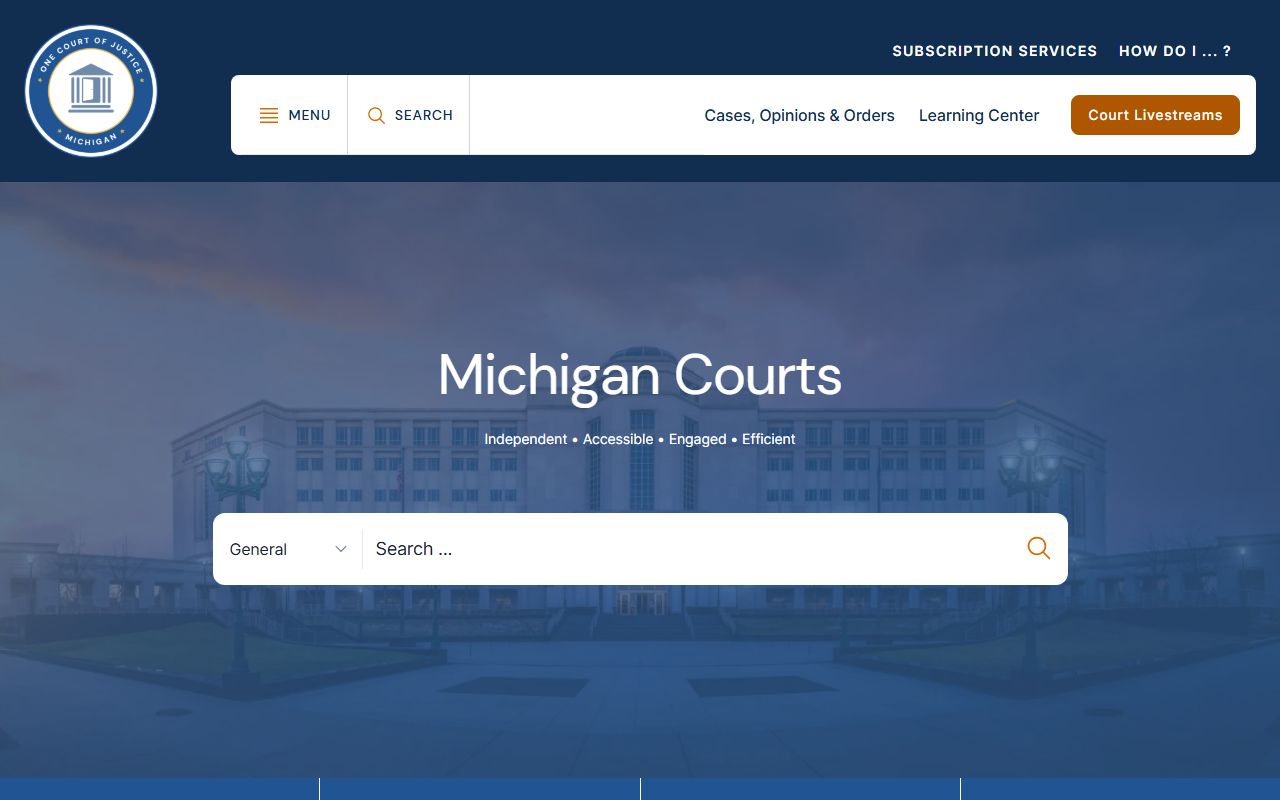
The Judicial Branch page is the umbrella reference for state court rules that shape how Ingham County arrest data ends up in the public docket.
The Ingham County Booking Process
An arrest record is opened the moment a person is brought into the Ingham County Jail. The booking process follows a set order. The arresting officer hands the person off to jail staff. The person is searched. Medical screening is done. A photo is taken. Fingerprints are scanned. The booking clerk types the charges, the arresting agency, and the personal information into the jail management system. A booking number is assigned. The new record then flows to the public side of the Ingham County Inmate Locator, often within a few hours.
After booking, the person is classified for housing. The classification step weighs the charge level, prior history, medical needs, and any mental health flags. Once classified, the person moves to a housing unit and gets phone access under facility rules. The booking record is now live. Bond may be set under a schedule or by a judge. Felony arrests usually head to the 55th District Court for arraignment and preliminary proceedings, and then bind over to the 30th Judicial Circuit Court if probable cause is found. Misdemeanor and traffic criminal cases usually stay at the district level.
Note: Arrest records appear on the public locator as soon as booking is complete, but court docket entries can lag by a day or two depending on filing.
What an Ingham County Arrest Record Shows
The Ingham County Inmate Locator profile is the core arrest record on the public side. The CAPTCHA on the locator blocked a full automated sample, but the field set the locator is built around is well known from the form and from the jail's published policies. The list below is the inventory of fields that appear on a current booking profile, with a short note on what each one tells the reader.
| Field | What It Shows |
|---|---|
| Full Inmate Name | Legal name used at booking, sometimes with middle initial or alias. |
| Inmate Number | The county booking number that ties all jail records to one person. |
| Booking Date and Time | When the person was logged into the jail management system. |
| Charges | Each charge filed at booking, with the Michigan code or local ordinance. |
| Bond Amount and Status | The cash or surety amount set, and whether it has been posted. |
| Housing or Custody Status | The jail unit or hold type, including transport and out of county holds. |
| Release Status | Shown when the person is no longer in custody, with date if posted. |
| Court Date | The next scheduled hearing in district or circuit court, when posted. |
| Arresting Agency | The police department or sheriff unit that made the arrest. |
The mugshot is part of the booking record but may or may not be shown on the public locator profile. Some fields stay hidden until court action is taken. Bond, for example, may show as set after the magistrate has reviewed the case. The arresting agency code is useful when more than one local department was involved in the same call. The Michigan State Police, Ingham County Sheriff, Lansing Police Department, East Lansing Police Department, Meridian Township Police, and Michigan State University Police all book through Ingham County Jail at times.
Victim names are not shown. The state portal at courts.ingham.org states that victim information is suppressed in the online criminal record search, and the same rule shapes what flows to the public arrest record.
Arrest Record vs Criminal Court Record
Arrest records and criminal court records are two different files made by two different offices. The arrest record is born at booking and belongs to the sheriff or police agency. The court record is born when the prosecutor files a charging document and belongs to the court clerk. They cover different stages of the same case and they update on different timelines.
| Arrest Record | Criminal Court Record | |
|---|---|---|
| Source Office | Ingham County Sheriff or local police | 30th Judicial Circuit Court or 55th District Court clerk |
| Created When | At booking, the same day as the arrest | When the prosecutor files a complaint or information |
| What It Contains | Booking data, charges at intake, mugshot, jail status, bond | Pleadings, motions, hearings, plea, sentence, appeals |
| Where to Access | jail.ingham.org and police blotters | courts.ingham.org and the Clerk of the Circuit Court |
| Update Lag | Often within hours of booking | One to several days from filing |
| Stays Online For | Current custody only; drops off at release | Years; criminal data goes back to 2000 on the portal |
An arrest does not mean a case will be filed. The prosecutor may decline to charge, send the file back for more investigation, or reduce the charges. When that happens, the arrest record still exists on the sheriff side, but no matching court record opens. For the full court history of any Ingham County case, the Ingham County court records page covers Circuit and Probate Court searches in detail.
Charges vs Convictions
A charge and a conviction are not the same thing. A charge is what the prosecutor accuses a person of doing. A conviction is what the court enters after a guilty plea, a no contest plea, or a verdict. The Ingham County Inmate Locator shows charges at booking. Those charges can change, be dropped, or be reduced as the case moves through court. The conviction shows up later, if at all, on the court docket and in any state criminal history report.
| Charge | Conviction | |
|---|---|---|
| Legal Meaning | A formal accusation by police or prosecutor | A court finding that the person is guilty of the offense |
| Burden of Proof | Probable cause | Beyond a reasonable doubt |
| Where It Shows | Arrest record, jail roster, charging document | Court judgment, ICHAT, sentencing order |
| Outcome Possible | Drop, reduce, dismiss, or bind over | Probation, fine, jail, prison, or community sanction |
| Effect on ICHAT | Not listed unless a conviction follows | Listed as an adult conviction record |
The distinction matters when arrest data is read out of context. A person can have an arrest record with several charges and still have no conviction. That can happen after a dismissal with prejudice, a finding of not guilty, a deferred plea that ends without judgment, or a successful diversion under one of the specialty court programs that the 30th Circuit and 55th District operate.
Mugshots and Jail Photos
Mugshots are taken as part of the Ingham County booking workflow. The county jail uses the photo for identification, classification, and release verification. The Ingham County Inmate Locator may or may not display the mugshot on a profile depending on case type and the policy in effect at the time of the search. The locator is the only official county source for the photo. Police agency blotters sometimes publish booking photos, and news outlets cover high profile arrests, but those are not the official record.
Michigan has no broad statute that bars all mugshot publication. Courts treat booking photos as part of the public record under Michigan FOIA and court rules unless a specific exemption applies. Juvenile booking photos, sealed cases, and any image of a victim are not public. A person who wants a mugshot taken off a third party site has no easy legal tool; the photo originated with the jail and may have been copied many times.
Confirming the photo and the booking data goes through the Sheriff and the jail directly. The locator is the canonical source.
Juvenile and Confidential Arrest Records
Juvenile arrest records are not public in the same way adult records are. Michigan juvenile records are governed by MCL 712A.28, which restricts access to court records and social files for cases handled by the Family Division. Access is allowed for parties, attorneys, agencies, law enforcement, and people with a court order. The general public does not see juvenile booking entries on the locator. The Family Division and the Clerk of the Circuit Court control who sees what.
Other arrest entries that stay off the public side include sealed warrants, ongoing investigation files held by police, grand jury matters, and records protected by the Michigan Mental Health Code at MCL 330.1748. The Ingham County court search portal also blocks personal protection order case information under MCR 3.705 and suppresses all victim information.
Adoption records, mental health treatment records in Probate Court, and any case sealed by court order under MCR 8.119 are off limits as well. A person seeking confidential records must file the right motion or qualify under the statute that controls the file type.
- Juvenile delinquency records under MCL 712A.28
- Adoption records under MCL 710.67
- Mental health records under MCL 330.1748
- PPO cases under MCR 3.705
- Sealed criminal records and set aside convictions under MCL 780.621
Official Michigan Criminal History
For a sworn adult criminal history check tied to a person, the Michigan State Police ICHAT system is the official source. ICHAT runs through the state at apps.michigan.gov/ICHAT. The system pulls statewide conviction records based on a name and date of birth, with a small fee per search. ICHAT will not show arrests that did not lead to charges. It will not show juvenile records. It will not show federal cases. For those, the Bureau of Prisons locator, PACER, and the federal court system are the right tools.
A fingerprint based check is more accurate than a name based check. Employers, schools, and licensing agencies that need a name and fingerprint match work through the Michigan State Police fingerprint program. ICHAT name based reports are commonly used by landlords, journalists, and family members who want a quick read on a person's adult Michigan record.
The Michigan Sex Offender Registry is a separate official database run by the Michigan State Police. It lists people required to register after qualifying convictions and shows the offense, conviction date, photo, address area, and tier.
The registry page can be reached at mspsor.com and is the only official statewide source for current sex offender status in Ingham County.
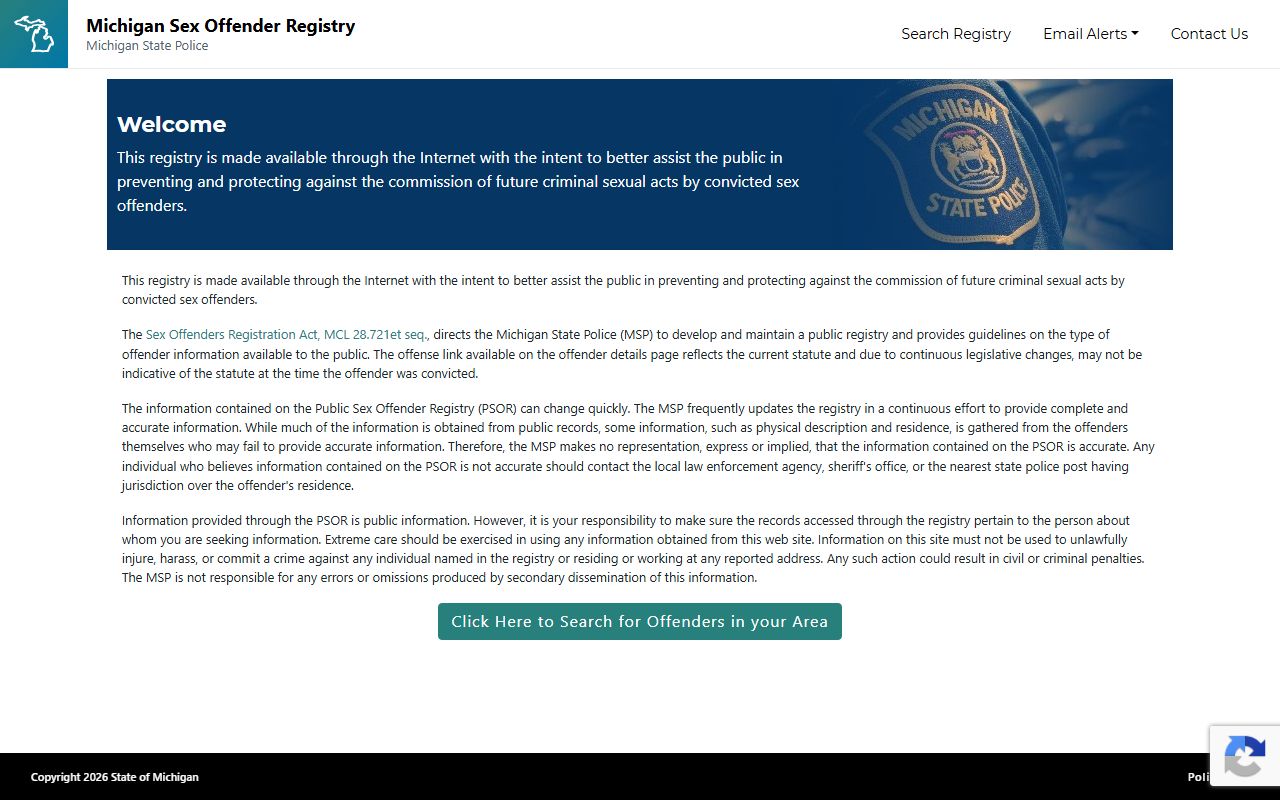
The registry returns name, photo, offense, and address area for each person required to report, and is updated by the Michigan State Police on a rolling basis.
Custody alerts for Ingham County inmates are tracked through VINELink, a free system that sends a phone, email, or text alert when a person is moved or released.
The signup page is at vinelink.com and the service covers state prison and county jail status across Michigan.
VINELink does not replace the inmate locator for daily lookups, but it is the simplest way to get an automated alert when a person's custody status changes in Ingham County.
Set-Aside and Sealing of Criminal Records
Michigan uses the term set aside rather than expungement, but the two words refer to the same legal process. A set aside removes a qualifying conviction from the public criminal record. The rules are set in MCL 780.621, and the legal effect of an order is set in MCL 780.623. A petition is filed in the court that entered the conviction, in Ingham County that is usually the 30th Circuit Court or the 55th District Court. The petitioner serves the prosecutor, the Michigan State Police, and the Attorney General, and attends a hearing unless the relief is automatic under the Clean Slate rules.
Sealing is a related but narrower step. A sealed record is hidden from public view but still exists in the court file and can be reached by law enforcement, the courts, and some licensing bodies. A set aside record is treated by statute as if the conviction had not occurred for most public uses, with limited exceptions.
| Sealed Record | Set Aside (Expunged) | |
|---|---|---|
| Legal Basis | MCR 8.119 and case specific orders | MCL 780.621 and MCL 780.623 |
| What Happens | Public access blocked; file kept by court | Conviction treated as not having occurred for most purposes |
| Who Can Still See It | Courts, parties, agencies with court order | Law enforcement, courts, licensing bodies, and the AG |
| Effect on ICHAT | Limited public display | Removed from public ICHAT report |
| Common Use Case | Sensitive civil filings and PPO cases | Old misdemeanors and qualifying felonies |
Michigan's Clean Slate law layered automatic set asides on top of the petition process. Eligible convictions can be set aside without a filing once the waiting period has run and the case meets the statute. Serious offenses, traffic offenses linked to operating while intoxicated under older law, and certain assaultive crimes are excluded. The Clerk of the Circuit Court at the Clerk of the Circuit Court page can confirm which Ingham County files have been processed under the automatic rules.
Important: A set aside under MCL 780.623 limits public access but does not erase every government trace; courts, police, and licensing agencies still see the record.
Connected Ingham County Records
An arrest record sits in the middle of a wider record set. The jail roster shows current custody, the warrant list shows who police are looking for, and the court file shows what happens after charges are filed. Each piece is tracked separately and each one has its own page on this site.
- Current jail bookings and inmate status: Ingham County inmate records
- Open and active warrants from the 55th District Court: Ingham County warrant records
- Full court files for Circuit and Probate cases: Ingham County court records
- Hearing calendars and daily dockets: Ingham County court dockets
- Traffic and misdemeanor case records: Ingham County traffic court records
- Public records requests under Michigan FOIA: Ingham County public records
Note: This site is not a consumer reporting agency under the Fair Credit Reporting Act, and the data here cannot be used for credit, employment, tenant, or insurance screening.