
How to Search Ingham County Probate Records
The main tool for an Ingham County probate records search is the Ingham County Circuit and Probate Court Record Search. The portal title reads "Ingham County, Michigan - Court Record Search." The same form searches Circuit Court files or Probate Court files, but only one court at a time. To pull probate matters, the user must pick the Probate radio button at the top of the form. Coverage for Ingham probate cases goes back to 1986. Online matches from the Ingham search tool are leads, not the official record. To view the certified file or get a copy, a person must go to the Ingham County Probate Court Probate Register's Office during public filing hours.
A few items help before any Ingham probate search. Have the full legal name of the person who died, the ward, or the trust. Have the case number if it is on a notice or a court paper. Pick Probate, not Circuit, in the court selector. Probate searches in Ingham do not need party type or case type. Last name supports a wildcard with at least two letters. First name takes one or more letters. For a business or trust party, use the business name field and leave out punctuation. The Ingham probate portal does not show personal protection order files, since those are blocked from the public view under MCR 3.705 even though most PPO work sits in Circuit Court.
- Open the Ingham County Court Record Search page and pick the Probate radio button. The tool searches one Ingham court at a time.
- Type the last name or business name. Use at least two letters. Skip commas and periods.
- Add the first name or initial if it is known. Probate searches do not need date of birth, party type, or case type.
- Use the year range fields to narrow the result list when the matter is old. Ingham probate data starts at 1986.
- Click Search. Treat any hit as a lead. The official Ingham probate record sits with the Probate Register's Office.
- If a case number is known, use the case-number search at searchByCase.do and pick Probate as the court.
What the Ingham County Probate Court Handles
The Ingham County Probate Court is a separate county court, not a part of the 30th Judicial Circuit Court or the 55th Judicial District Court. It has its own bench, its own forms, its own fee schedule, and its own filing room. Its job is to handle a set of family and property matters that Michigan law sends to probate, not to general civil court.
The Ingham probate bench hears wills filed for safekeeping, the probate of a will after a death, the appointment of a personal representative for a decedent estate, the supervision of trusts and trustees, the appointment of guardians and conservators for minors, adults, and developmentally disabled persons, and mental health treatment cases. Each of those matters has its own track. A decedent estate moves through notice to heirs and creditors, an inventory of assets, claims, an accounting, and a final order of distribution. A guardianship of a minor or an adult moves through petition, hearing, appointment, and annual reports. A conservatorship is the money side and runs on a yearly accounting. Mental health treatment cases run under the Michigan Mental Health Code and stay off the public file in most respects.
- Wills filed for safekeeping and probate of wills after death
- Decedent estates, including formal and informal probate
- Trusts and trust supervision
- Guardianships for minors, adults, and developmentally disabled persons
- Conservatorships for financial management
- Small estate assignments for low-value estates
- Mental health treatment proceedings
Probate Records Search Field Notes
The Ingham search form is shared with Circuit Court, so the field layout looks the same on both sides. The Probate side acts a bit different though. The court selector must be set to Probate. Once Probate is picked, the party type box and case type box become optional. Probate cases do not use plaintiff and defendant the same way a civil case does. The petitioner files. The ward, the decedent, or the trust is the subject. Heirs, creditors, and interested persons are listed in the file but are not searched the same way as a civil party.
The last name field on the Ingham probate side takes at least two letters and supports wildcards. Typing "SM" will pull Smith, Smithton, and similar names. The first name field takes one letter or more. The date of birth field is not needed for an Ingham probate search. The portal asks for DOB for criminal and traffic only. Trusts and businesses go in the business name field. Year range filters help when the file is old, since Ingham probate data starts in 1986. The Search button runs the query and the Clear button resets the form.
The result list on an Ingham probate search shows case number, party name, case type, and file date. Click the case to open the docket entries. Probate dockets carry filing events such as petition for probate of will, letters of authority, notice to creditors, inventory filed, fiduciary acceptance, annual account, and order of distribution. The portal does not show the imaged file itself. A user who wants a copy of the will, the inventory, or any order must ask the Probate Register's Office.
Filing Forms and the Mandatory SCAO Requirement
The Ingham County Probate Court posts a notice that form use is mandatory. The court cites MCL 600.855 and Michigan Court Rule 5.113(A) and says all filings must be on the most current SCAO-approved form when one exists. SCAO stands for the State Court Administrative Office. SCAO forms are the standard Michigan court forms used statewide and posted by the Michigan Supreme Court. If a current SCAO form covers the petition or report, that is the form Ingham probate filers must use.
The Ingham probate forms page links the full set of forms used in the county: petitions to commence probate, applications for informal probate, acceptance of appointment for a personal representative, fiduciary inventories, notices to creditors, sworn statements, annual accounts, petitions for guardianship and conservatorship, annual reports of guardian, annual accounts of conservator, and small estate assignment forms. The county page is at probate court forms and resources. The Michigan SCAO forms library at courts.michigan.gov holds the master form set used in every county probate court.
Note: A filing made on an old SCAO form or a non-SCAO form may be rejected at intake under MCR 5.113(A), so check the form date before printing.
Probate Records Access at the Register's Office
The Ingham County Probate Court page says the public may review public case records at the Probate Register's Office during public filing hours. The Probate Register is the office that holds the official paper file for each Ingham probate case. It is the probate side of what the County Clerk is to Circuit Court files. Computer terminals, paper file pulls, and copy services are handled there.
Ingham County Probate Court
Probate Register's Office
Ingham County, MI
Public filing hours posted on the official page
Online Court Services
Ingham County Probate Court
Online services and record links
Available 24/7 for portal use
For a confidential matter such as a mental health treatment case, a minor guardianship, or a sealed estate, the Probate Register cannot release the file to a member of the public. A party, an attorney of record, or someone with a court order can ask for access. The Register's Office also handles certified copies and exemplified copies for use in other states. Verify the current public hours and any closure notices on the official Probate Court page before going in.
Probate Court Fees
Ingham County Probate Court keeps a separate fee schedule that covers filing fees, inventory fees, and copy fees. Filing fees are set by Michigan statute. Inventory fees are set as a sliding amount based on the value of the estate, and the Ingham probate page links an inventory fee calculator. Copy and certification fees are charged at the Register's Office for paper copies of files.
The Ingham probate fee schedule is posted at the official Probate Court fee schedule page, which lists each fee item and its current amount.
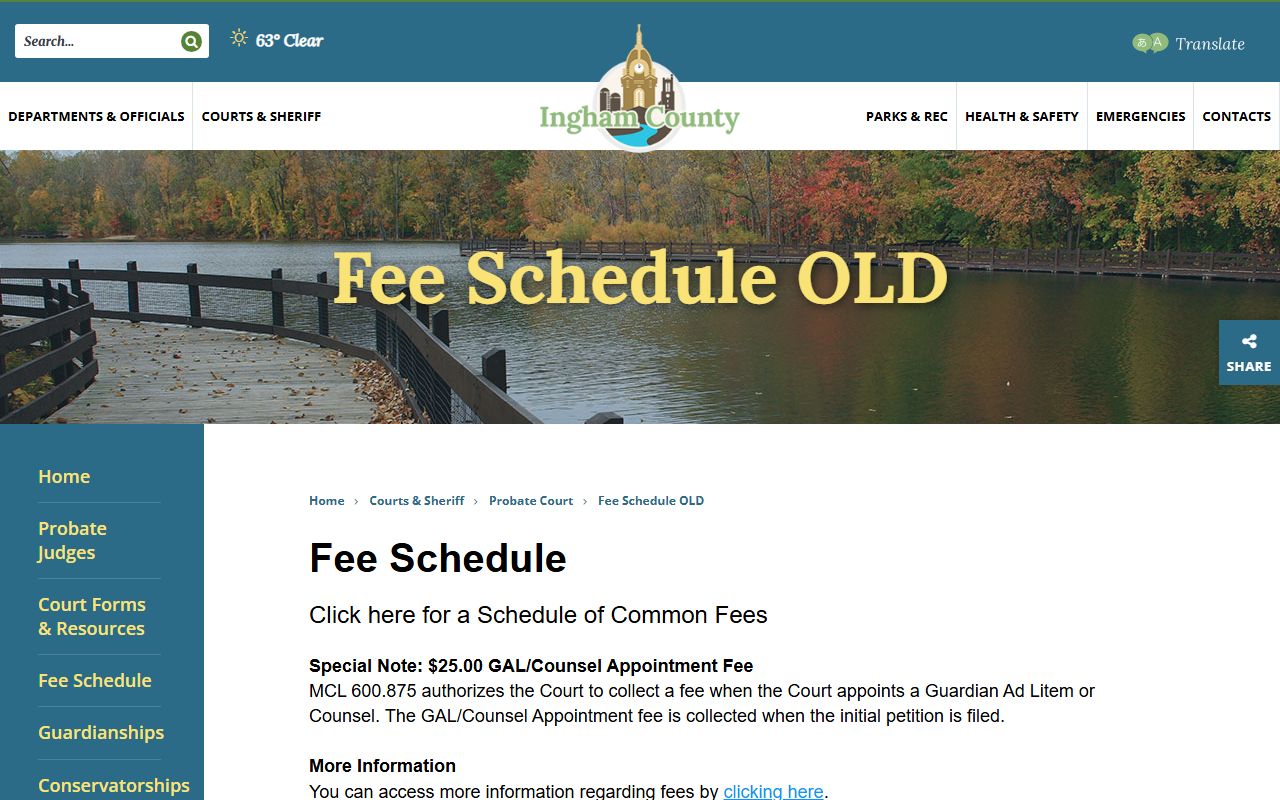
The image above shows the layout of the Ingham probate fee schedule page, which is where current dollar amounts for filing, inventory, and copy fees should be verified before a filing is dropped off.
| Item | Amount / Source |
|---|---|
| Probate filing fees (estates, guardianships, conservatorships, trusts) | See the official Ingham Probate Court fee schedule |
| Inventory fee on a decedent estate | Sliding amount, computed by the Ingham probate inventory fee calculator |
| Certified copy of a probate order, letters, or will | See the official Probate Court fee schedule |
| Plain copy per page from a probate file | See the official Probate Court fee schedule |
| Exemplified copy for out-of-state use | See the official Probate Court fee schedule |
Note: Amounts can change without much notice, so the official Ingham Probate Court fee schedule is the source of record for any dollar figure used in a filing.
Probate Glossary
Probate has its own set of terms, and the Ingham probate file uses these words on the docket and in the orders. A short glossary helps a non-lawyer read a probate case the right way.
- Testator
- The person who signed the will. After death the will is filed with the Ingham Probate Court for probate.
- Executor (Personal Representative)
- The person named in the will or appointed by the court to gather assets, pay debts, and pass the rest to the heirs. Michigan now uses the term Personal Representative on most forms.
- Intestate
- Dying with no will. Michigan intestacy rules set who gets what, and the Ingham Probate Court opens an estate under those rules.
- Guardianship
- A court order that lets one person make personal care choices for a minor, an adult, or a developmentally disabled person who cannot make those choices alone.
- Conservatorship
- A court order that lets one person manage money and property for a ward. Conservators file an annual account with the Ingham Probate Court.
- Inventory
- A sworn list of all the assets owned by a decedent or a ward as of the date of death or the date of appointment. The inventory drives the Michigan inventory fee.
- SCAO forms
- The State Court Administrative Office forms used statewide. Ingham probate requires the most current SCAO form for every filing where one exists.
- Small Estate Assignment
- A short-cut probate path for low-value estates under Michigan law that avoids a full estate proceeding.
Small Estate Assignment
Not every Ingham County estate needs a full probate file. Michigan law sets a small estate path for estates whose value falls below a statutory cap that is adjusted by the state from time to time. The Ingham County Probate Court page lists Small Estate Assignment as one of its standard topic pages, which means it is a common Ingham filing.
The small estate path uses a sworn petition by the surviving spouse or heir. The court checks the value of the estate, the funeral and burial costs, and the debts of the decedent. If the math fits the statute, the court orders an assignment of the remaining assets. There is no full personal representative appointment, no notice to creditors, no inventory fee on the full estate, and no formal closing. The savings in time and cost can be large for a small estate.
An Ingham filer who is thinking about the small estate path should first pull a list of the decedent assets and debts. Bank accounts in joint name and assets with a named beneficiary often pass outside of probate, which can drop the estate value below the cap. The current SCAO petition for assignment of property must be used.
Mental Health Treatment Proceedings
Mental health treatment cases are heard in Ingham County Probate Court, not in Circuit Court. These cases cover a petition for involuntary mental health treatment, a hearing on the petition, and an order for treatment if the court finds the legal standard is met. The Probate Court page lists Mental Health Information as one of its standard topic areas.
Mental health files in Ingham probate are not public in the same way that a decedent estate is. The Michigan Mental Health Code, including MCL 330.1748, controls disclosure of mental health information. A recipient's records, the contents of the petition, the testimony at the hearing, and the order can be released only to a defined set of people and only under defined conditions. A member of the public cannot pull a mental health treatment file from the Probate Register the way they would pull a decedent estate.
Note: A search for a person in the Ingham probate portal can show that a mental health case exists, but the file content is held back under the Mental Health Code, so a request for copies will be denied unless the requester has a legal right to the file.